
For almost four decades, Thailand has quietly provided refuge to people fleeing decades of conflict and instability in Myanmar. Around 110,000 refugees live in nine temporary shelters along the Thailand–Myanmar border. Behind bamboo walls and leaves roofs, life in the camps is shaped by uncertainty — limited movement, lack of work opportunities, and barriers to formal justice systems. Yet, amid these challenges, a quiet transformation has taken root: refugees helping refugees understand and access justice.
One of the strongest examples of that transformation can be found in Mae La Camp, where Saw Day Day, known to many as Saw Re, has spent nearly two decades working to bring fairness and understanding into his community.
Building Justice from Within
When the International Rescue Committee (IRC) launched its Legal Assistance Center (LAC) project in 2007, the goal was not only to provide legal aid but to build local capacity within the camps. Many refugees struggled to understand Thai laws or where to seek help when their rights were violated. With restrictions on movement, most legal cases rarely reached the formal justice system, leaving communities to rely on traditional or informal methods of dispute resolution.
To bridge this gap, IRC, with approval from the Ministry of Interior and in partnership with the United Nations High Commissioner for Refugees (UNHCR), established the Community Legal Volunteer (CLV) program. The idea was simple but powerful: identify community members who were respected, willing to learn, and committed to helping others, and train them in basic legal knowledge, rights awareness, case documentation, and referral procedures.
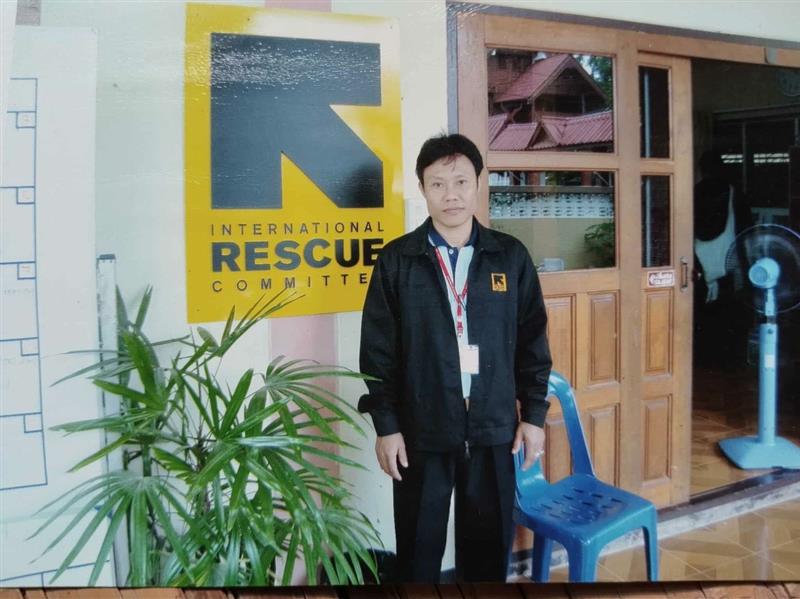
These volunteers — often called paralegals — became the first point of contact for people seeking justice inside the camps. They listen to survivors, record information accurately, and link cases to Thai authorities or humanitarian agencies when needed. Over time, CLVs became bridges between the refugee community and the outside legal system — trusted by both sides.
“The law used to feel very far from us,” Saw Day Day recalled. “When people had problems, they didn’t know what to do or who to talk to. But when they see someone from their own community explain things clearly, they start to believe that justice can work for them too.”
A Journey of Service and Growth
Saw Day Day arrived in Thailand in 2006, fleeing the violence that had engulfed his village in Myanmar. He settled in a small house in Mae La Camp. Two years later, in 2008, he began volunteering with IRC’s Rule of Law program as a Community-Based Assistant (CBA), helping raise awareness about rights and responsibilities. His calm personality and ability to listen soon earned him respect in the community.
When the CLV program was introduced in 2016, he was among the first to sign up. “I didn’t have much education,” he said, “but I knew how to talk to people and how to help them solve problems. I wanted to learn more about the law so that I could guide them better.”

Over time, Saw Day Day became one of the most experienced volunteers in the camp. He worked closely with IRC staff, Thai officials, and the Ministry of Interior’s shelter commanders to ensure that serious protection cases — such as sexual violence, child abuse, and domestic violence — were reported and handled properly.
Today, he also serves as a camp leader, but he has never stopped being a paralegal at heart. He continues to coach new CLVs, reminding them that listening, empathy, and patience are as important as legal knowledge.
Justice for the Most Vulnerable
One case that still stays with him happened in 2023, when a young woman with mental health challenges was sexually assaulted by an unknown man. It was one of the most difficult cases the team had ever faced. The survivor could not easily communicate, and her sister had to speak on her behalf.
As one of the Community Legal Volunteers, Saw Day Day played a key role from the very beginning. He provided basic legal advice to the survivor’s family, helping them understand what could be done under Thai law and what steps to take next. He then referred the case to IRC’s legal team for formal case management and continued to act as a bridge between the family, the community, and the authorities. Throughout the long investigation, he helped ensure that information flowed smoothly — updating the family on progress, coordinating with the camp’s multidisciplinary protection team and law enforcement.
Despite the complexity, the case was investigated through the Thai justice system, and eventually a final court judgment was reached. The Rights and Liberties Protection Department (RLPD), under the Ministry of Justice, later approved financial compensation of 50,000 THB, which was delivered to the survivor’s family with IRC’s support.
“It wasn’t just about the money,” said Saw Day Day. “It was about showing the community that justice can reach even those who are often forgotten. It gave people courage to come forward when something bad happens.”

The Role of Paralegals in Refugee Protection
Stories like Saw Day Day’s show how powerful community-based justice can be. In places where access to formal courts is limited, paralegals are often the first and only bridge to the legal system. They help people understand their rights, record cases accurately, and prevent community tensions from escalating. They also work to reduce stigma around sensitive issues like gender-based violence and disability, ensuring that survivors are treated with dignity and confidentiality.
The IRC’s paralegal network now operates across five camps in Tak and Mae Hong Son Provinces, with Community Legal Volunteers serving as essential connectors between refugees, local authorities, and justice institutions. Many of these volunteers, like Saw Day Day, have served for years — not for recognition or income, but out of genuine commitment to fairness.
A Lasting Impact
Today, as he balances his duties as a camp leader and legal volunteer, Saw Day Day continues to be a symbol of quiet strength. His journey from displaced person to community advocate reflects the broader purpose of the CLV program — to empower refugees not just to receive aid, but to shape their own systems of fairness, accountability, and respect.
Through volunteers like Saw Day Day, justice in the camps is no longer an abstract idea. It lives in every conversation, every mediation, and every act of courage that keeps the community united — proving that even in exile, people can build their own foundation of rights and dignity.
About the International Rescue Committee
The International Rescue Committee (IRC) is a global humanitarian organization founded in 1933 at the call of Albert Einstein to support people fleeing persecution and conflict. Today, the IRC works in over 40 countries and crisis-affected communities to provide lifesaving support, protect rights, and help people rebuild their lives with dignity. Our programs focus on health, protection, education, economic empowerment, and durable solutions for displaced populations.
In Thailand, the IRC has been working since 1976 to support refugees and vulnerable migrants along the Thailand–Myanmar border. We provide essential services including healthcare, protection, legal assistance, and livelihood opportunities in refugee camps, Emergency, and Disaster Risk Reduction. The IRC also supports long-term pathways toward safety and economic independence, including expanded access to legal work and skill development aligned with the evolving refugee context in Thailand.
![[BUR] တိတ်ဆိတ်နေသံများကို ချိုးဖျက်ခြင်း – သဘာဝဘေးသင့် လူထုရဲ့ မမြင်နိုင်တဲ့ ဒဏ်ရာတွေကို ကုစားပေးခြင်း](https://alternativelawgroups.ph/wp-content/uploads/2025/12/Braveheart-Photo-400x250.jpg)
![[TH] จากผู้หนีภัยการสู้รบสู่ผู้พิทักษ์สิทธิ: เมื่ออาสาสมัครกฎหมายชุมชนกลายเป็นกระบอกเสียงแห่งความยุติธรรมในพื้นที่พักพิงชั่วคราว](https://alternativelawgroups.ph/wp-content/uploads/2025/12/Image-9-400x250.jpg)