
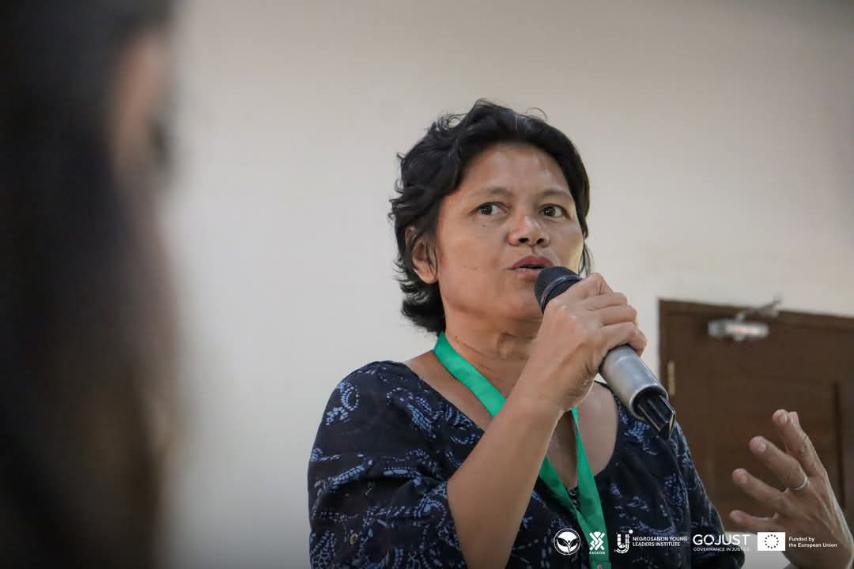
In Negros Occidental, a silent, persistent revolution is led by Girlie Arilla, a dedicated land rights paralegal and advocate for the Modesto Jalandoni Farmers Association (MOJAFAS). Initially focused on combating violence against women and children, Girlie’s activism has evolved to confront the deeper issue of landlessness, which she identifies as a root cause of gendered oppression.
“Ti-on na nga mga trabahador ang mag-angkon sang duta nga ila gin pangabudlayan sa madugay nga panahon”. (“We must dismantle this cycle at its core.”), she asserts, reflecting the resilience that defines MOJAFAS and its mission for justice.
MOJAFAS represents a group of Agrarian Reform Beneficiaries (ARBs) in Barangay Calumangan, Bago City, whose fight for land rights spans decades. Despite numerous setbacks, the association has transitioned to a more comprehensive approach to their struggle, employing innovative strategies that combine paralegal, metalegal, and digital communications tools. These methods not only aim to secure land rights but also advance gender justice within the community.
The urgency of this fight became painfully clear when families, driven by hunger and the lack of decent livelihoods, decided to occupy the land they had been waiting for under the Comprehensive Agrarian Reform Program (CARP). “We invoked our usufructuary rights to till the land as identified CARP beneficiaries, even though it is still titled to the Republic of the Philippines,” Girlie explains, highlighting the desperate measures taken by the farmers to claim their rightful livelihoods.
A Community of One Barangay Calumangan, Bago City, Negros Occidental
MOJAFAS has taken significant steps toward legal empowerment and community organization. During a recent meeting, community members expressed their collective desire for support services. “We want to access legal assistance, but we often face roadblocks,” Girlie shares, noting that the Department of Agrarian Reform (DAR) has been hesitant to provide the necessary support. “They don’t recognize us as an association, which makes it difficult for us to gain access to services.”
Yet, despite these challenges, Girlie and her fellow ARBs remain undeterred. “We are a community of around 78 members, and we are planning to hold elections to ensure that we represent everyone’s voice. It’s essential that we collaborate and not just rely on one leader,” she asserts, emphasizing the importance of shared leadership in their advocacy.

To address their pressing needs, Girlie and MOJAFAS have begun to utilize digital platforms to disseminate information and mobilize support. “We’ve started using social media to post about our activities and achievements. Our friends see the positive comments and are encouraged to join our cause,” she says, reflecting on the power of community engagement.
With digital tools and social media, Girlie published their stories, hoping that the digital community would see their lived realities and their fight for their land.
Alternative approach to achieving justice
One of the most notable innovations in MOJAFAS’s approach has been their focus on paralegal training, empowering community members to understand their rights and navigate the legal system. “We need to know the law to use it effectively,” Girlie emphasizes. “This knowledge allows us to shape the law and advocate for our rights.”
The organization has also initiated a paralegal clinic to provide legal support and guidance to ARBs. “During our campouts, we conduct workshops and legal consultations to ensure that everyone is informed and equipped to defend their rights,” she explains. This proactive strategy has helped foster a sense of agency among community members.
In addition, Girlie highlights the role of community-generated data in strengthening their advocacy. “We document everything—from land occupations to our economic activities. This data supports our claims and provides tangible evidence of our struggle,” she states, showcasing the importance of leveraging information for justice.
Women, girls, and the equal fight for land rights
While securing land rights is a central focus for MOJAFAS, Girlie is keenly aware of the intersectionality of their struggles. “We cannot talk about land rights without addressing gender violence. The two issues are deeply intertwined,” she asserts. By framing their fight for land as a fight for gender justice, Girlie and MOJAFAS have highlighted the need for a holistic approach to community empowerment.
At a recent community gathering, Girlie shared her vision for a more just and equitable society. “We must educate our community about gender issues, ensuring that everyone understands the importance of protecting our women and children,” she urged. This emphasis on education and awareness has galvanized community members to stand against violence and discrimination.
She believes that it is vital for their community to hold more spaces for women and girls to take up leadership positions and not be confined to their households. Girlie showed that women have the capacity to mold an inclusive community, only when women and girls are empowered to take more spaces.
Hope for the Future
As Girlie reflects on the journey ahead, she remains optimistic. “The struggle is far from over, but we have made significant strides. We are no longer just victims; we are advocates and leaders in our own right,” she declares. The strength of MOJAFAS lies not only in their fight for land but also in their commitment to dismantling the systemic barriers that perpetuate gendered oppression.
With plans to renew their documents with the Department of Labor and Employment (DOLE) and pursue accreditation, Girlie is determined to secure a sustainable future for her community. “We want to ensure that our voices are heard, and our rights are upheld. Together, we can create change,” she asserts, embodying the hope and resilience of the farmers of Negros Occidental
As the sun sets over the verdant fields of Negros, Girlie Arilla and the members of MOJAFAS stand united, ready to continue their fight for justice, equality, and a future where every individual has access to the land and rights they deserve.
“Land is not just land—it’s survival, dignity, and a future for our children,” Girlie concludes.
Story by NYLI Inc, Kevin Gaitan with reports from Jannele Jimenez and Bless Ann Tio.
![[TH] จุดเปลี่ยนครั้งสำคัญ: ชัยชนะทางกฎหมายของ “เขาคูหา” ที่สร้างประวัติศาสตร์ด้านสิทธิชุมชนและความยุติธรรมสิ่งแวดล้อม](https://alternativelawgroups.ph/wp-content/uploads/2025/10/WhatsApp-Image-2025-08-08-at-18.24.39-400x250.jpeg)
