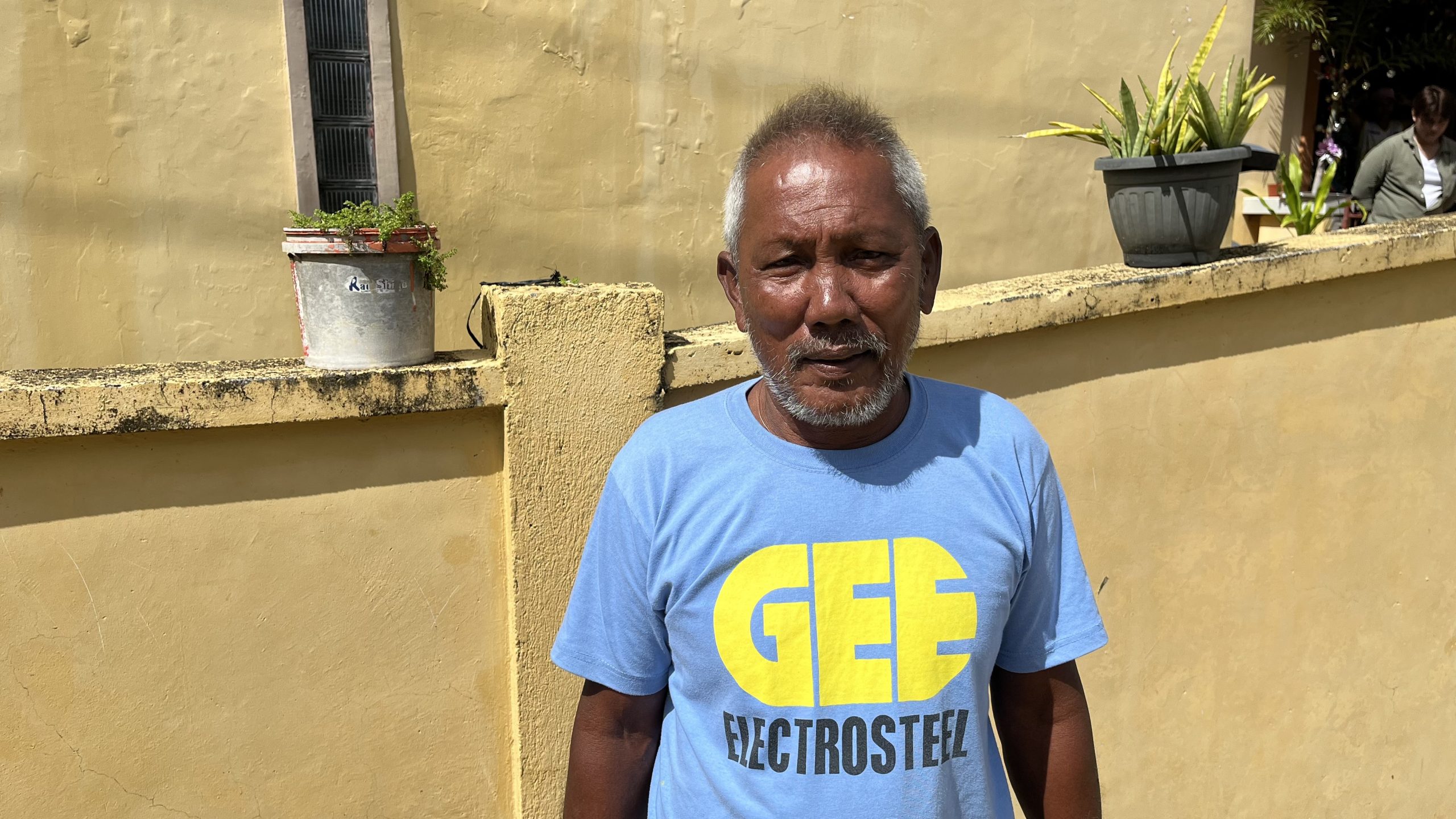
“Padayon ako nga nagios tungod nga it akon pagkita man gud, diri akon kundi para hit bug-os na Manicani, ma-pro o ma-ma-diri, anti o pro, nga tanan hira akon gin proproteharan, labi na it sumusunod na henerasyon. Kay nadiri ako nga pag-abot hiton panahon nga iton Manicani nagkukuri na, babasulon kami…kay waray namon proteheri an hinimo han diyos para ha aton,” says Marcial Abit Somooc, the 65-year-old Protect Manicani Island Society Inc. (PROMISI) president. He has been the group’s president since 2007, taking the reins after the group transitioned from its former name.
(I keep doing this because I am not just doing this for me but for the entire Manicani, whether you’re pro or anti, I am protecting everyone, especially the next generation. If the time comes that the situation in Manicani would fair for the worse, I do not want them to blame us for failing to protect what God had provided for us.)
“1989 han naging member na ako han SAMAMO, gud man dida han 2007 kinahanglan namon mag-iba kahuman magka may-ada insidente kun diin nakahibang an usa ha amon mieymbro. Tikang hadto, naging PROMISI na kami, ngan paging PROMISI namon, ako an ira ginpili na presidente,” he said.
(I became a member of SAMAMO in 1989, however, in 2007, we had to change our name because of an incident where one of our members hurt somebody. From then on, we became PROMISI and when we became PROMISI, they chose me as their president.)
Tatay Gaing, as he is fondly called, has been standing up for the rights of his community since 1989, when a wave of mining grants raced through what is now called the Guiuan Marine Resource Protected Seascape and Landscape Area; back then, the Philippine Protected Area Systems under R.A. 7586 had yet to be established.
He recalls that at that time, the community’s main livelihood was primarily agriculture and fishing, with the islands of Homonhon and Manicani being the main supplier of calamansi in the area. However, agricultural lands on the island have been taken over by the mining company, and what little fish stock remains near the island’s coast has been affected by tailings coming from the mines. At the same time, the livelihood of the isle has drastically changed, with almost 80% of residents employed by the mining company or earning through them in varying capacities.
“Hadto, an amon pakabuhi pagdagat ngan pag uma, yana di na kami nakag uma kay okupado na han mina. An akon igin-tubuan, akon igindako, hasta nga nag-asawa, hasta nga magka mayda apo, may nam uma; pag sulod han mina nagtikang na karuba,” he said.
(Back then, our livelihood consisted of farming and fishing, now, we can no longer do that since the mine had taken over our farm. I grew up, lived, got married, and had grandchildren because of farming, but when the mine came, it all started to crumble.)
Being at the center of the island’s fight for freedom from the plague of mining, Tatay Gaing is no stranger to legal and metalegal actions that members of their community have been through, to thwart the creeping encroachment of the mining company in their area.
In 2002, with the help of the Diocese of Borongan, members of the community were able to push for the suspension of the mining company’s 25-year Mineral Production Sharing Agreement (MPSA) with the Philippine Government for illegal mining practices. Between then and now, however, while the same suspension was still in place, this did not deter the mining company from intruding into the island.
In 2014, a barge registered as the M/V Isabel Uno departed the port of Tacloban and headed toward the causeway in Brgy. Buenavista, Manicani Island, Guiuan, Eastern Samar; onboard were heavy equipment to gather nickel ore stockpiles left behind because of the company’s suspension.
In response to this, Tatay Gaing, with members of his organization, on board ten or so fishing boats, held a seaborne rally in hopes of convincing the crew of the barge to no longer pursue docking at the island. Their efforts fell in vain, however, as despite having a wide berth to avoid a collision, the barge rammed through their protest line, sinking the boat where Tatay Gaing and his younger comrade, Josephine Delantar, were in.

“Gasi ko hadto asya na am kamatay; maupay na gud la nga damo an am upod nga nakadto para maghatag hin ayuda,” he said.
(“I thought we’d die there. We were lucky we had our companions there to help us.”)
Following this incident, Tatay Gaing would be involved in several cases, both against the mining company and those within their community who actively supported them. In 2016, Tatay Gaing, alongside Rebecca Destajo, another community leader, filed a Petition for Continuing Mandamus before the Court of Appeals to prohibit the mining company from collecting the ore stockpiles on the island. Later, both of them filed cases for declaratory relief against the legislative bodies of the four barangays in Manicani Island, the Sangguniang Bayan of Guiuan, Eastern Samar, and the Provincial Legislature of the Province of Samar for issuing Resolutions Interposing No Objection to the HMC’s application for the renewal of their MPSA in 2017. This was while still pursuing the case for attempted murder against the operator of the barge and some community members related to the 2014 ramming incident.
That is not to say that Tatay Gaing has not been on the other side of the table. In 2019, he faced perjury charges from a community member whom he implicated in the attempted murder case. This was ultimately dismissed as a SLAPP suit. To this day, Tatay Gaing continues to live in constant fear of reprisals from the mining company and the local government, which he laments as not only cooperative but supportive of mining companies in the area.
“Ha munisipyo, waray namon paglaum … tikang ha barangay, munisipyo, hiton probinsya pabor hiton pagmina,” he said.
(We don’t see much hope with the government, from the barangay, the municipality, and up to the province. They all favor mining.)

While admittedly fearing for his safety and that of his family, Tatay Gaing remains undeterred in his community’s fight against the intrusion of mining and its threats to their island.
Today, Tatay Gaing continues to be active in his community. He regularly appears as a guest on local radio shows like Radio Natin Guiuan to talk about the issues and threats of mining in their area and to promote the importance of environmental conservation to a wider community. In 2023, Tatay Gaing sought to run as Punong Barangay in Buenavista, Manicani Island, but unfortunately lost.
Nevertheless, Tatay Gaing remains hopeful, looking forward to the day when his community will be free from mining activities. He also encourages the next generation to stand up for their community and help preserve the island for their sake.
“Hingyap ko, ma-istop totally an mina para it Manicani mahi-preserbar hit sumurunod ngan para hit magburugto, pamilya nga nagburublag, magka-urusa ngahaw. Para liwat hadton masunod na henerasyon an akon advice na diri hira mahadlok o mabaraka pagtindog para han Manicani kay katungod naton ini pag-proteher han aton isla,” he said.
(I hope that mining in Manicani will stop so that we can preserve it for those coming next and also for brothers and sisters and family members who have been separated by mining, to come together. For the next generation, my advice is to not be afraid or worry about standing up for Manicani because it is our right to protect our island.)
Manicani Island is part of the Guiuan Marine Resource Protected Seascape and Landscape Area. It comprises four barangays, namely Buenavista, Banaag, Hamurawon, and San Jose. In 1994, under Presidential Proclamation No. 469, Manicani and the rest of the Municipality of Guiuan were made part of the Philippine Protected Area System.
In March 2022, despite their claim already having expired, the Philippine Government, through the Department of Environment and Natural Resources, lifted the 2002 suspension against the mining company and granted it another fifteen years of operation, claiming that their actions were force majeure.
As of this writing, load-carrying transports have appeared off the coast of Manicani Island, transporting mineral ores from the island. The mining company has also applied to expand its claim on Manicani Island.
To this day, Tatay Gaing’s fight carries on.
Story by Rafael Greggorre Pajares of the Environmental Legal Assistance Center (ELAC) – Eastern Visayas.