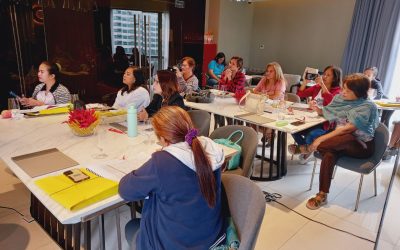
The Grassroots Justice Network-Southeast Asia (GJN-SEA), led by its regional anchor, the Alternative Law Groups (ALG), conducted the first-ever regional paralegal exchange which gathered community-based paralegals and grassroots justice defenders from different SEA nations on August 15-17, 2024 in Bangkok, Thailand.
More than 60 grassroots justice defenders attended the exchange–with 32 community-based paralegals from Cambodia, Indonesia, Laos, Malaysia, Myanmar, Philippines, and Thailand.
For GJN-SEA, nearly all civil society organizations (CSOs) use paralegal development as a common legal empowerment approach. Still, there is a lack of wider opportunities to expand this strategy in the region.
During his welcome message, Vivek Maru, Chief Executive Officer of Namati, emphasized the important role of paralegals in bridging the laws to communities and ensuring these laws are understood.
The regional paralegal exchange aimed to gather input and recommendations on key thematic needs and issues of community-based paralegals, identify priority areas, and develop a regional agenda for paralegals.
Visioning For the Future
Community-based paralegals have always been at the heart of legal empowerment, as highlighted by Marlon Manuel, Senior Advisor of Namati, during his discussion on paralegalism. He said that paralegals could know and understand the law, use the law to address justice issues and shape the law to correct systemic injustices.

Tom Weerachat, Global Lead on Community-Led Advocacy of the International Accountability Project (IAP), led a visioning exercise for the participants to envision an ideal world for paralegals in the next three to five years.
For a participant from Malaysia, an ideal world is where “everyone is treated equally, with dignity, and with due process.”
The participants were asked to draw their visions on a blank canvas that will be posted to the wall for the rest of the exchange – a reminder of the world they envisioned for paralegals like them.
“I am drawing the scale that represents equality. I want everyone to have equal rights and have access to justice,” a participant from Laos said.

Meanwhile, a participant from the Philippines drew a hand, a bird, and a torch. “My drawing is a hand representing paralegals helping the community. The bird is the expression of freedom, and the torch is the champion–gold medal for us paralegals,” they said.
The Advocacy Themes
Before the regional paralegal exchange, the core group members of the GJN-SEA conducted in-country paralegal exchanges to capture information and experiences of as many paralegals from their countries as possible.
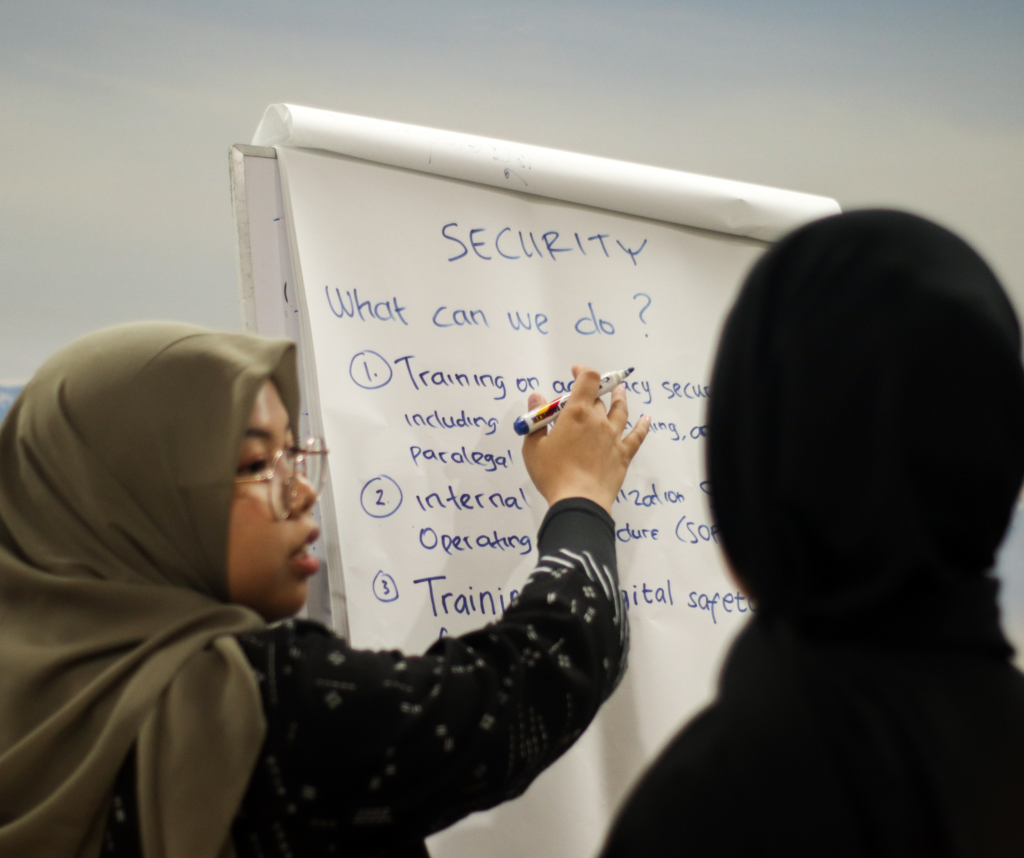
The four advocacy themes are (1) security, (2) recognition and sustainability, (3) capacity building and (4) solidarity. The consolidated results of the in-country paralegal exchanges were presented to the participants, and they underwent a series of workshops to identify areas of priority for the regional agenda.
For security, the top issue that needs to be addressed is the threats, violence, and harassment (in physical and digital forms) faced by paralegals while doing their work. They also said dealing with repression from the state (surveillance, digital regulation and crackdown, security checks) and criminalization (detentions, arrests, and trumped-up cases) must also be prioritized.
One of the participants from Indonesia said, “Many people in the organization have been criminalized. So many people have been arrested. State and security forces and corporations work together to criminalize them. Instead of protecting them, the [government] sides with the corporations.”
Meanwhile, the participants exchanged views about whether it is necessary to have a formal recognition for paralegals. In SEA, only Indonesia has a formal recognition of paralegals in their national law, but it is not well-implemented on the ground as they still face threats and harassment from state forces.
For some, a formal recognition might limit the work of community-based paralegals so they prefer an informal or no recognition at all. One participant from Thailand who prefers informal recognition cited the do-no-harm principle. They said that a formal recognition may put paralegals more at risk, especially in the context of refugees and asylum seekers.
On sustainability, the participants reaffirmed the results of the in-country paralegal exchange: the lack of financial and human resources remains a challenge and there is a need for continuous capacity building and psychosocial support for paralegals to sustain their work.
In terms of capacity building, the participants identified the following as areas of priority, among others:
- Legal education (including new laws and amendments, regional updates, and legal mechanisms and procedures)
- Security (including physical and digital security)
- Community Organizing (including building community power and doing action research)
- Psychological Support (mental health and psychosocial support)
“We are already living in a high-stress environment. We should provide accessible [psychosocial] support, something that is understandable to their language,” a refugee paralegal said.
Community Visits and Learning Sessions
As part of the learning agenda of the exchange, participants visited different Thailand-based organizations working with grassroots communities on various justice and human rights issues in the country. These organizations include Asylum Access Thailand (AAT), Thai Lawyers for Human Rights (TLHR), Thammasat University Law Center, Cross Cultural Foundation (CrCF), and Human Rights and Development Foundation (HRDF).
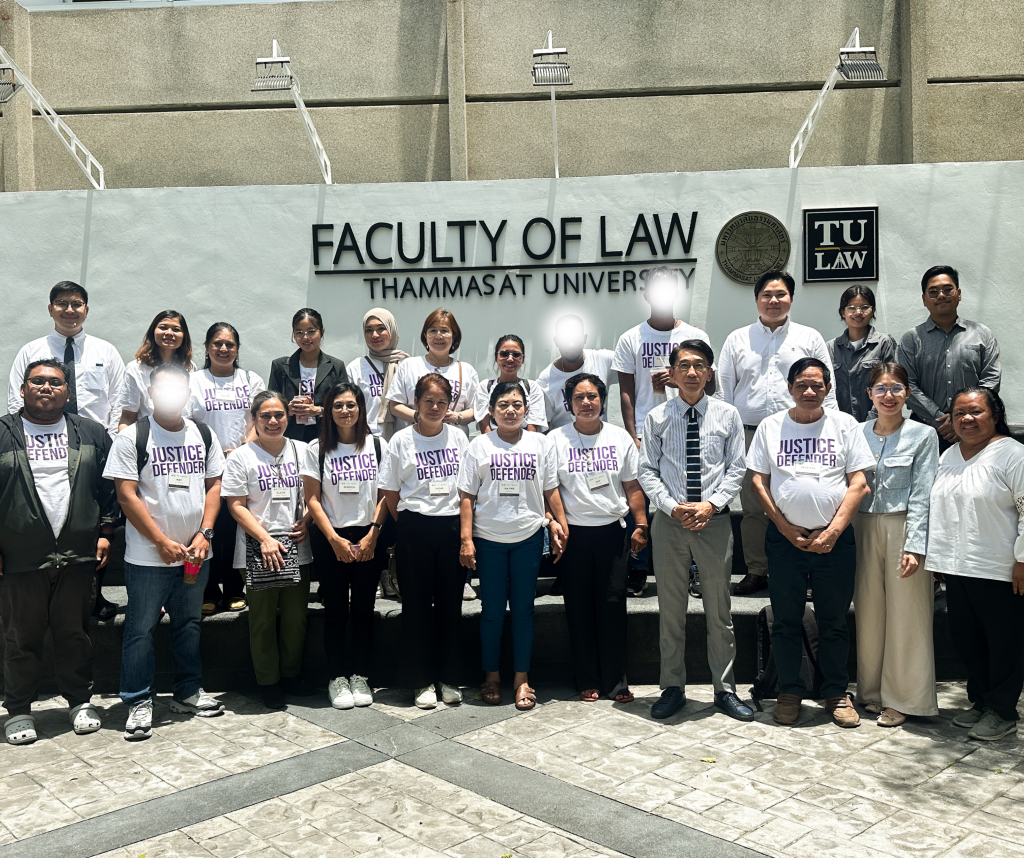
“I got to know for sure how the AAT team does things, how they help refugees, and how they solve their problems. As a group, AAT teaches refugees vocational skills, generates income through handicrafts, and generates income by selling food online,” a Myanmar participant shared in their reflection.
A community-based paralegal from the Philippines who works with persons deprived of liberty (PDLs) learned about Thailand PDLs from TLHR. “It was shocking to learn that only 31 baht per day is allocated for each PDL, a meager amount that scarcely meets their basic needs. The lack of adequate water in the jails further exacerbates these harsh living conditions, reflecting a situation alarmingly similar to that faced by PDLs in the Philippines.”
Six learning sessions were conducted to further capacitate the community-based paralegals on different topics related to their work. These include artistic approaches to legal empowerment, social media and advocacy, gender mainstreaming, action research, legal empowerment for refugees in low-resource settings, and monitoring and evaluation.
National and Regional Agenda of Paralegals
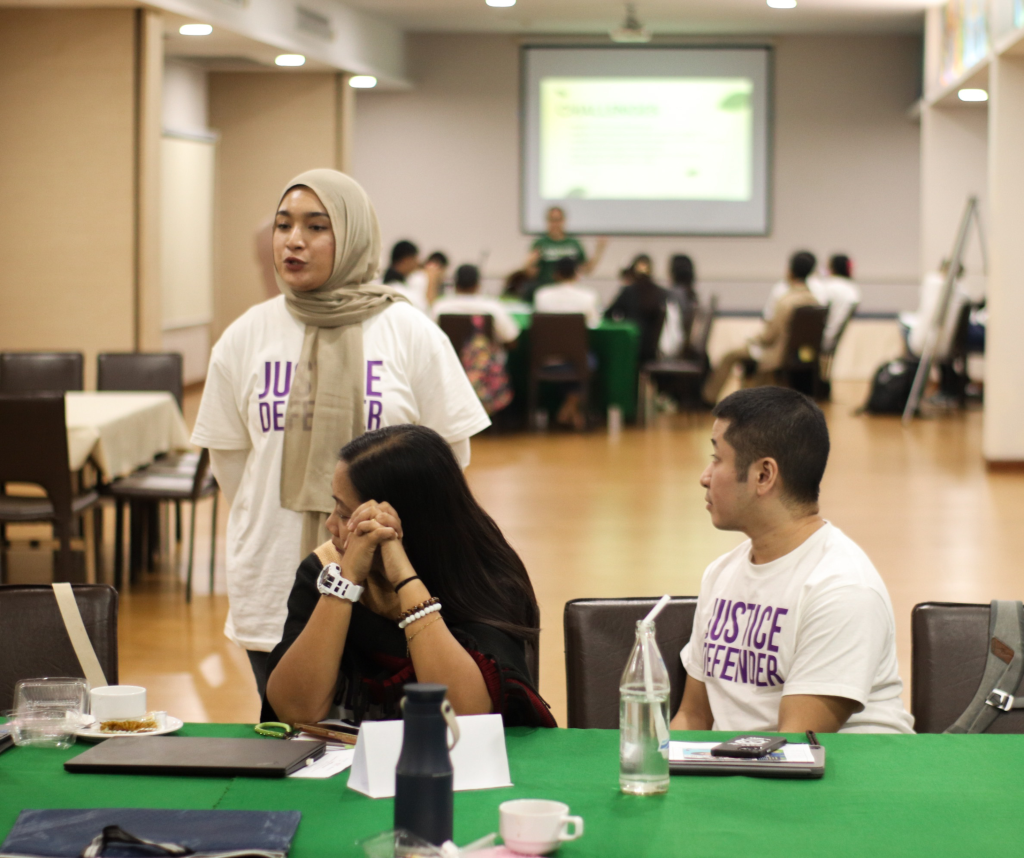
During the third day, participants from the same countries worked together to develop their national agenda and the regional agenda for paralegals in Southeast Asia.
For the regional agenda, the participants prioritized activities including engaging donors to support paralegal work, working with ASEAN bodies and mechanisms, physical and digital security training, and overcoming language barrier issues, among others.
The regional agenda of paralegals will be finalized by the GJN-SEA core group members during the regional convening in September 2024 in Palawan, Philippines.
This event is supported by the International Development Research Centre, Ottawa, Canada, and Namati.